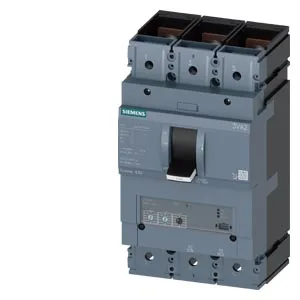
Rated 630 A continuous at 40 °C, it handles the full load of a high-current bus without nuisance tripping. The interrupting capacity is the headline number here: 330 kA at 240 V AC, 242 kA at 415 V and 440 V, 187 kA at 500 V, and 9 kA at 690 V — so it can safely clear a fault on a transformer secondary or a large industrial service entrance where available fault current runs high. That 330 kA figure at 240 V means it's sized for the worst-case bolted fault on a 240 V delta or 277/480 V wye system where the transformer can dump that kind of energy. The adjustable trip unit lets you set the long-time pickup between 945 A and 5670 A — that's 1.5× to 9× the 630 A frame rating — so you can coordinate it with downstream breakers without oversizing the frame. The 3-pole construction covers three-phase systems.
Mounting and integration in the panel
The 138 mm width for a 3-pole frame means it occupies roughly 5.4 inches of panel width per breaker; plan your bus bar takeoffs and wire bending space accordingly. It's a bolted-frame mount, not a plug-in base, so you'll need the panel's mounting plate drilled for the Siemens 3VA footprint. A shunt trip (STL) release is built in, so you can remotely trip the breaker from an E-stop or a PLC output. No undervoltage release is fitted, so if you need UVR for a machine safety circuit, you'll add it externally or spec a different variant.
At 45 °C it's 612 A; at 50 °C, 593 A; at 55 °C, 575 A; at 60 °C, 557 A; at 65 °C, 538 A; at 70 °C, 520 A (–).