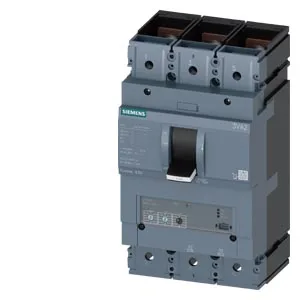
What this breaker brings to the panel
The 3VA2463-7HL32-0KL0: Breaking capacity is the headline: 330 kA at 240 V, 242 kA at 415 V and 440 V, 187 kA at 500 V, and still 52.5 kA at 690 V. No communication module onboard — this is a standalone breaker, not a networked power monitor. If you need data logging or remote trip indication, you'll add the optional communication module separately.
It measures 110 mm deep, 138 mm wide, and 248 mm tall. That's a standard SENTRON 3VA footprint — it'll drop into the same mounting cutout as other 3VA2 frame breakers. The 138 mm width is the same as the 3VA2 630 A frame, so if you're swapping out an older 3VF or 3VL breaker, check the mounting hole pattern; the 3VA series uses a different bolt spacing than the 3VL. Power loss is 162 W maximum at full rated current. The breaker's rated for ambient operation from -25 °C up to 70 °C, but the continuous current derates above 40 °C: 612 A at 45 °C, 593 A at 50 °C, 575 A at 55 °C, 557 A at 60 °C, 538 A at 65 °C, and 520 A at 70 °C.
Auxiliary and trip accessories
The shunt trip is the supplied basic switch variant 3VA2463-7HL32-0AA0, and the integrated auxiliary trip is 3VA9688-0BL33. No undervoltage release, no phase-failure detection, and no ground-fault monitoring as standard — those are add-on options if your application needs them.