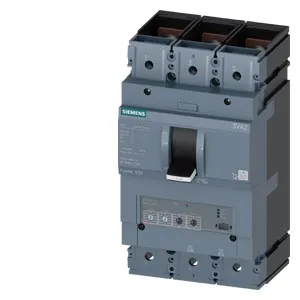
What this 630 A MCCB carries — and what it means for your panel
That 630 A is the thermal rating at 40 °C; above that, the breaker derates in a published curve — 612 A at 45 °C, 593 A at 50 °C, 575 A at 55 °C, 557 A at 60 °C, 538 A at 65 °C, and 520 A at 70 °C. Breaking capacity is the other headline: 330 kA at 240 V, 242 kA at 415 V and 440 V, 187 kA at 500 V, and 52.5 kA at 690 V. The overcurrent release is an ETU350 electronic trip unit — adjustable, with LSI protection curves (long-time, short-time, instantaneous). An undervoltage release (UVR) is built in, part number 3VA9608-0BB11, which drops the breaker on loss of control voltage.
Dimensions: 138 mm wide, 248 mm high, 110 mm deep. That 110 mm depth is the body depth — account for handle throw and cable bending radius behind the panel. Maximum power loss is 164.5 W — that heat stays inside the enclosure, so factor it into your thermal budget.
The base switch (the breaker without auxiliaries) is order code 3VA2463-7HN32-0AA0. The integrated auxiliary trip is 3VA9608-0BB11. These are separate line items if you need spares for the aux components.
What it guards — and what it doesn't
Product version is 'Line protection' — this is a feeder breaker for cable and busbar protection, not a motor circuit protector. It has no phase failure detection and no communication function. The trip indicator is also absent, so fault indication relies on the auxiliary switches or a separate indicator module. Mechanical endurance is 15,000 operations — adequate for a distribution breaker that cycles infrequently. For frequent switching duty (like a welding line or capacitor bank), consider a contactor in series.