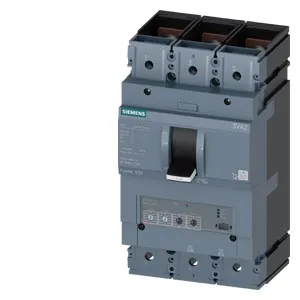
The Siemens SENTRON 3VA2463-7HN32-0BH0 is a 3-pole molded case circuit breaker rated for 630 A continuous current (Iu) at 40 °C ambient, with the ETU350 electronic trip unit governing the overload and short-circuit protection curve. Per the datasheet, the breaker carries a rated insulation voltage of 800 V and delivers a breaking capacity of 330 kA at 240 V AC, stepping down to 242 kA at 415/440 V and 187 kA at 500 V — the figure that governs fault clearance at your service voltage. The 630 A frame is the rating that determines busbar and cable sizing upstream; the thermal derating table from 40 °C through 70 °C (630 A down to 520 A) is what you apply when the breaker lives in a warm enclosure.
Trip unit, auxiliary contacts, and undervoltage release
The integrated auxiliary trip module carries order code 3VA9608-0BB11, which is the service part if the release needs replacement. Maximum power loss through the breaker at rated current is 164.5 W — relevant for thermal management inside a closed panel.
Dimensions are 248 mm high × 138 mm wide × 110 mm deep — a standard 3-pole MCCB footprint for 630 A frames, designed for screw-mounting on a mounting plate or DIN rail adapter.