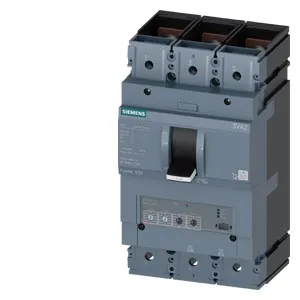
It carries an ETU350 electronic overcurrent release, which provides adjustable protection curves without needing a separate trip unit — the release is integrated into the breaker frame.
Interrupting capacity — what the voltages mean
The interrupting rating varies by system voltage: 330 kA at 240 V, 242 kA at 415 V and 440 V, 187 kA at 500 V, and 52.5 kA at 690 V. At 690 V the 52.5 kA rating still covers most industrial motor-control centers; the 330 kA at 240 V is overkill for branch circuits but exactly what a 240 V switchboard needs when backed by a large transformer.
Thermal derating — real-world current capacity
Rated 630 A at 40 °C ambient, but the breaker must be derated as panel temperature rises: 612 A at 45 °C, 593 A at 50 °C, 575 A at 55 °C, 557 A at 60 °C, 538 A at 65 °C, and 520 A at 70 °C. If your enclosure runs hot — common in sealed, sun-exposed or high-density panels — the 70 °C figure (520 A) is the one to design against. The maximum power loss is 164.5 W, which drives internal cabinet heating. Factor that into your ventilation or cooling budget when clustering several breakers in one enclosure.
Dimensions are 248 mm high, 138 mm wide, 110 mm deep — a standard 3-pole MCCB footprint for Siemens SENTRON 3VA frames at this rating. Verify the mounting cutout and bus-bar spacing against your existing panel layout before ordering. The storage limits govern handling and warehousing, not running conditions.