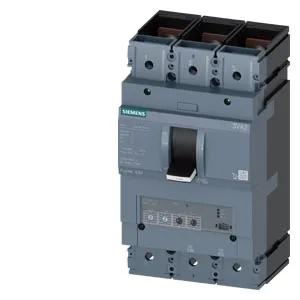
It's built around the ETU350 electronic trip unit — that's the brains behind the selective coordination and adjustable overload/short-circuit protection curves. The 630 A rating is the current at 40 °C ambient. Above that, the breaker must be derated: at 50 °C it carries 593 A, at 60 °C it drops to 557 A, and at 70 °C it's down to 520 A. The trip alarm switch signals the breaker's open state due to a fault, not just manual switching. These are the internal components that the panel builder or maintenance team would reference when ordering spare aux blocks or replacement trip units.
At 500 V it drops to 187 kA, and at 690 V it's 52.5 kA. If your system's available fault current at the breaker's line terminals is, say, 200 kA at 500 V, this breaker still holds margin. For a 690 V wind-turbine or mining application, the 52.5 kA rating is the limit to check against the transformer impedance and cable length.
This is a fixed-mount MCCB — no draw-out cradle. The 138 mm width is three-pole wide, standard for this frame size. Verify the panel cutout or mounting plate spacing against the 110 mm depth, especially if the breaker is mounted near the back panel where busbars or cable ducts run behind it. The maximum power loss of 164.5 W means the enclosure needs enough free-air volume or forced ventilation to keep internal ambient below the 70 °C operating maximum.