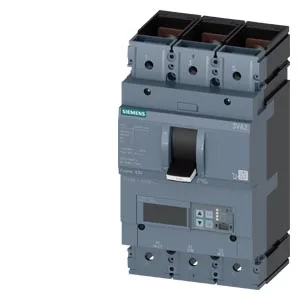
What this 630 A MCCB is and what the ratings mean for the panel
The Siemens 3VA2463-7KQ32-0AA0 is a SENTRON molded case circuit breaker (MCCB) rated 630 A continuous at 40 °C, with an ETU860 electronic trip unit. That 630 A figure is the current it can carry continuously without tripping at 40 °C ambient — above that temperature it must be derated: 600 A at 45 °C, 570 A at 50 °C, and so on down to 450 A at 70 °C. The ETU860 is a programmable overcurrent release that supports LSIG protection (long-time, short-time, instantaneous, ground-fault) and includes a communication function for remote monitoring. The 3-pole design handles three-phase loads up to 800 V insulation voltage. Breaking capacity is the other headline: 330 kA at 240 V, 242 kA at 415 V and 440 V, 187 kA at 500 V, and 9 kA at 690 V. At typical 400 V distribution levels, 242 kA means this breaker can safely interrupt a fault current up to that level without welding contacts or cascading upstream — it's sized for high-fault panels like main switchboards or large feeder breakers. The IP40 rating on the front means the breaker face is protected against tools and wires over 1 mm, but the body is not sealed against water; it's a panel-mount device, not a washdown enclosure.
Panel fit and integration
Dimensions: 248 mm height, 138 mm width, 110 mm depth. The 138 mm width is the standard 3-pole MCCB footprint — it fits a typical panel cutout for a 630 A frame. The 110 mm depth includes the arc chamber and terminals; verify rear clearance for the arc chutes and cable bend radius. The ETU860 draws the listed 162 W max power loss at full load, which must be factored into the panel thermal budget. Ground-fault monitoring uses summation current formation on the L-conductor. No undervoltage release or voltage trigger is fitted on this variant.
