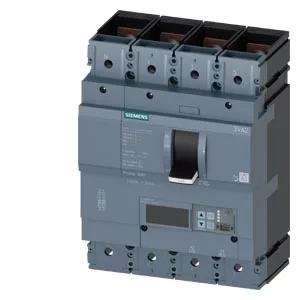
It uses the ETU550 electronic trip unit, which gives you adjustable long-time, short-time, instantaneous, and ground-fault protection curves — not a fixed thermal-magnetic, so you can dial in coordination with downstream breakers without swapping hardware. Breaking capacity runs 440 kA at 240 V, 330 kA at 415 V and 440 V, 220 kA at 500 V, and 52.5 kA at 690 V. That puts it in the high-interrupting range — sized for transformer secondaries or large bus feeds where fault current is serious. It carries a communication function and an optional motor drive, so it can be integrated into a remote-controlled distribution scheme — think PLC-triggered load shedding or SCADA-operated bus couplers.
At 45 °C it's 600 A; at 50 °C, 570 A; at 55 °C, 540 A; at 60 °C, 510 A; at 65 °C, 480 A; at 70 °C, 450 A. Maximum power loss is 162 W; that heat has to be considered in the enclosure thermal calculation, especially if multiple breakers are ganged.
How it compares to the 3VA2010-8HL42-0AA0
The 3VA2010-8HL42-0AA0 is a smaller-frame MCCB — typically 100 A class, 3-pole, with a lower interrupting rating. The 3VA2463-8JP42-0AA0 is a full-size 630 A, 4-pole frame. They share the SENTRON 3VA platform and the same ETU trip family, but the 3VA2010 will not physically fit into a panel cutout designed for the 3VA2463, and vice versa. If your panel was specified around the 3VA2010, the 3VA2463 will not drop in without reworking the mounting and bus connections.