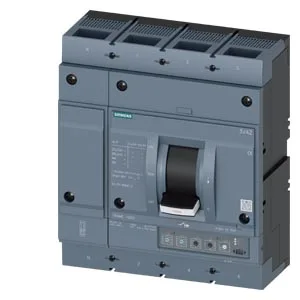
What this 1000 A MCCB means on the line
Above that, it derates: still 1000 A at 55 °C, then 955 A at 60 °C, 885 A at 65 °C, and 815 A at 70 °C (–). The interrupting capacity is the headline here: 187 kA at 240 V, 121 kA at 415 V, and 53 kA at 690 V (–). Those numbers mean it can safely clear a massive fault — think a bolted short on a 2000 kVA transformer secondary — without blowing apart or welding contacts. That matters when you're feeding a panel with a shared neutral or a harmonic-rich load. The breaker is 280 mm wide, 320 mm tall, and 120 mm deep (–). That's a big frame — plan for a 280 mm cutout in your panel, and make sure the enclosure depth clears the 120 mm plus wiring space.
What the ETU350 trip unit gives you
The N-conductor protection can be set to OFF, 50%, or 100% of the phase current — critical when you're feeding a load that draws neutral current from non-linear loads like VFDs or UPS systems. The breaker also has a trip indicator so you can see at a glance if it opened on a fault, which saves time during troubleshooting.
Mounts in a standard panel on a mounting plate — no DIN rail for this frame size. The 280 mm width means you need to leave that much horizontal space plus clearance for arc chutes and cable bending radius. Maximum power loss is 123 W — that heat has to go somewhere, so don't bury it in a sealed box without ventilation or a derating calculation.