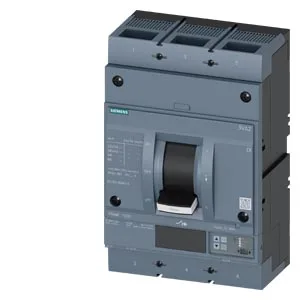
The Siemens 3VA2510-5KQ32-0CA0 is a SENTRON molded case circuit breaker (MCCB) rated for 1 000 A continuous current at 40 °C, with a rated insulation voltage of 800 V. The interrupting capacity is substantial: 187 kA at 240 V, 121 kA at 415 V, and 53 kA at 690 V. It carries an ETU860 electronic trip unit, which is the fully programmable, communicating tier in the 3VA family. The adjustable long-time pickup (Ir) ranges from 0.5 to 1 000 A, and the short-time delay (tsd) is settable from 0.05 s to 0.5 s. That level of adjustability lets you coordinate selectively with downstream breakers, keeping a faulted branch isolated while the main stays closed.
The breaker holds its full 1 000 A rating up to 55 °C ambient. Above that, it derates linearly: 955 A at 60 °C, 885 A at 65 °C, and 815 A at 70 °C. If your switchgear enclosure runs hot — say, a non-ventilated indoor cubicle near a furnace line — you need to apply that derating curve at the design stage, not after commissioning. Physical footprint: 210 mm wide (8.3 in), 320 mm tall (12.6 in), 120 mm deep. That 120 mm depth is the body-only dimension; add the rotary handle or motor operator projection when laying out the gland plate. Maximum power loss is 123 W at rated current. That's heat that must be evacuated from the enclosure — factor it into your ventilation or air-conditioning budget for the panel.
No N-conductor protection is built in (the design is marked 'Without'), so if you need neutral-ground fault detection, you add an external module or specify a different variant.
Communication and auxiliary functions
The ETU860 trip unit includes a communication function and an 'other measurement function' — this is the variant that can talk to a higher-level system (PROFIBUS, PROFINET, or Modbus via a communication module) for remote monitoring of current, power, and event logs. If you need that data feed for an energy management system or a predictive maintenance dashboard, this is the right trip unit tier. For a main breaker that operates a few times a year, that's effectively a lifetime; for a frequently switched load (like a welder or a furnace tap changer), it's a limit to track. The storage limit is wider because the breaker isn't dissipating heat when stored — that's the limit for warehousing or shipping in extreme climates, not for running.