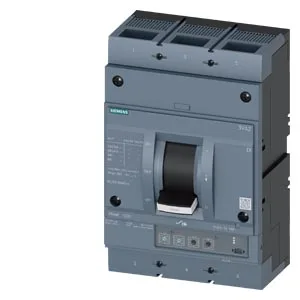
Rated continuous current Iu is 1000 A, and at 40 °C the breaker holds that rating flat; derating starts at 60 °C (955 A), dropping to 815 A at 70 °C. That thermal curve is the one to check if this lands in a hot enclosure or next to other high-current devices. Interrupting capacity is the headline number for a main breaker: 242 kA at 240 V, 187 kA at 415 V, and 74 kA at 690 V. Those figures cover most industrial service-entrance and high-fault panelboard applications, including installations where the available fault current exceeds 100 kA at the lower voltages. The ETU350 electronic trip unit gives adjustable long-time pickup (Ir) from 0.5 to 1.0 × Iu — so 500 A to 1000 A — and short-time delay (tsd) adjustable 0.04 to 0.4 seconds. That selectivity window is what a site electrical engineer uses to coordinate downstream breakers and keep a fault from taking out the whole bus.
Dimensions are 210 mm wide, 320 mm tall, 120 mm deep — a 3-pole frame that fits standard SENTRON mounting patterns. The 120 mm depth is the front-to-back projection behind the panel door; verify clearance against the backplane or busbar stack, especially if a rear-connection kit is used. No washdown rating; keep this inside a cabinet.
The ETU350 trip unit supports adjustable long-time, short-time, and instantaneous settings (li adjustable up to 10 000 A). No ground-fault monitoring version is fitted on this variant.