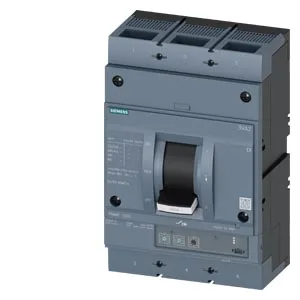
It's a 3-pole unit rated 800 A continuous current (Iu) across the 40 °C to 60 °C ambient range; at 65 °C it derates to 767 A, and at 70 °C to 703 A. That means for a panel sitting in a hot electrical room, you still get full 800 A up to 60 °C — a practical margin for most industrial environments. Breaking capacity is the headline: 187 kA at 240 V AC, 121 kA at 415 V, and 53 kA at 690 V. Those numbers tell you this breaker can interrupt very high fault currents — it's sized for main or feeder positions in high-capacity switchboards, not for branch circuits with low available fault current. The ETU320 electronic trip unit gives adjustable long-time pickup (Ir) from 320 A to 800 A, short-time pickup (Ii) from 1200 A to 8000 A, and long-time delay (tr) from 0.5 s to 17 s. That adjustability lets you coordinate selectivity with downstream breakers without changing hardware.
Physical footprint: 210 mm wide, 320 mm high, 120 mm deep.
Because the ETU320 allows independent adjustment of long-time, short-time, and instantaneous pickup, this breaker can be selectively coordinated with downstream MCCBs or fused switches. For a site electrical engineer setting up a selective coordination study per IEC 60947-2, the adjustable Ii range (1200–8000 A) and tr range (0.5–17 s) give enough curve shaping to avoid nuisance tripping on transformer inrush or motor starting, while still clearing a hard fault fast.