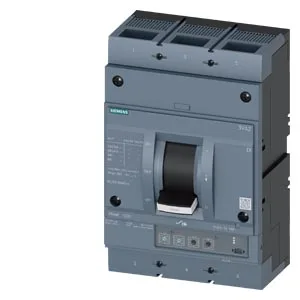
What the interrupting ratings mean for your fault-current study
Its headline figure is the interrupting capacity: 187 kA at 240 V, 121 kA at 415 V, and 53 kA at 690 V — these are the maximum fault currents it can safely clear at those voltages without welding or rupturing. That 187 kA at 240 V is the number your arc-flash study cares about if you're feeding a transformer secondary or a high-capacity bus; the 53 kA at 690 V tells you it holds up on 690 V industrial mains where many MCCBs derate hard.
Continuous current and thermal derating — the 800 A frame
At 65 °C it drops to 767 A; at 70 °C it's 703 A. If your enclosure runs hot from solar load or adjacent drives, that's the curve to check against your load. The ETU350 electronic trip unit handles the adjustable long-time (Ir 0.5–1× Iu, tr 0.5–17 s), short-time (Isd, tsd 0.04–0.4 s), and instantaneous (Ii up to 10× Iu) protection.
Physical fit — panel cutout and mounting
Dimensions are 320 mm high × 210 mm wide × 120 mm deep. That 120 mm depth is the key number for shallow backpanel clearance — verify your gland plate depth against it. The 210 mm width (8.3 in) means it occupies three 70 mm pole spaces in a typical MCCB lineup.