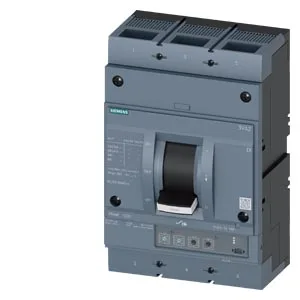
It's a line protection version — meaning it's the primary overcurrent device guarding a feeder or main bus, not a branch or motor circuit protector. The 800 A rating holds flat from 40 °C up to 60 °C, then derates to 767 A at 65 °C and 703 A at 70 °C, so in a hot panel you lose about 12% at the top end.
This breaker's interrupting capacity is 187 kA at 240 V, 121 kA at 415 V, and 53 kA at 690 V. Those are the maximum fault currents it can safely clear without welding or rupturing. If your service entrance or transformer secondary can deliver, say, 100 kA at 415 V, this MCCB handles it with margin. At 690 V the 53 kA figure still covers most industrial distribution — but verify your point-of-fault available current against that number.
ETU350 trip unit — adjustability range
The ETU350 electronic trip gives you adjustable long-time pickup (Ir) from 0.5× to 1× In — so 400 A to 800 A — and short-time pickup (Isd) with delay adjustable from 0.04 s to 0.4 s. Instantaneous pickup (Ii) goes up to 8000 A (10× In). That's enough selectivity range to coordinate with downstream breakers on a typical distribution board. The long-time delay tr is adjustable from 0.5 to 17 seconds, letting you ride through motor inrush without nuisance tripping.
Dimensions are 210 mm wide, 320 mm high, 120 mm deep — a 3-pole frame that fits standard switchboard cubicle mounting. Maximum power loss is 135 W at rated current — account for that heat in your panel thermal budget.