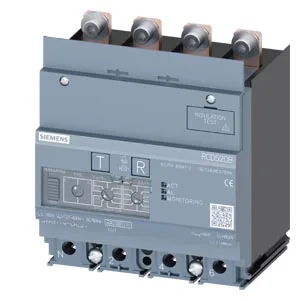
The Siemens SENTRON 3VA9114-0RL21 is a residual current protection module (RCD520B Basic) designed for load-side mounting on 3VA1 molded-case circuit breakers. It provides adjustable type B and B+ earth-leakage protection — the type B rating means it catches smooth DC fault currents from variable-speed drives, UPS systems, or PV inverters, not just AC and pulsed DC. That makes it the right module for mixed-load panels where VFDs share a bus with standard AC loads. Rated at 160 A continuous (4-pole), with a residual current trip threshold adjustable from 0.03 A up to 5 A and a time delay settable from 0 to 10,000 ms. The adjustability lets you coordinate selectivity downstream — set a longer delay on the main RCD so a feeder RCD clears first, keeping the rest of the panel live. Mounts via screw fixing and connects to the main circuit through a busbar connection. Infeed can enter from the top or bottom, which simplifies busbar routing in a crowded enclosure.
The 160 A rated operational current at AC matches the frame size of the 3VA1 breaker it attaches to — you don't oversize the RCD relative to the breaker, and the busbar connection keeps voltage drop across the module low. The 7.6 W maximum power loss is heat that must be considered in the enclosure's thermal budget; in a sealed panel with multiple modules, that adds up. The adjustable residual current response values — 0.03, 0.05, 0.1, 0.3, 0.5, 1, 3, 5 A — cover everything from personnel protection (30 mA) through equipment protection and fire-prevention levels. The type B+ characteristic extends the detection to smooth DC up to the rated level, which a standard AC/type A RCD would miss. For a panel feeding both VFD-driven conveyors and resistive heaters, this single module handles both leakage profiles. The pre-alarm indication at 30% of the set residual current gives an early warning before the RCD trips — useful in continuous-process lines where an unexpected shutdown costs production time. The selectable RCD or monitoring mode and selectable tripping characteristic add flexibility: you can configure it as a pure monitor (alarm only, no trip) during commissioning or for critical loads.
The storage range is wider, but the operating limit is what governs the panel ambient — if the enclosure sees sustained temperatures above 80 °C, derating or forced cooling is needed.