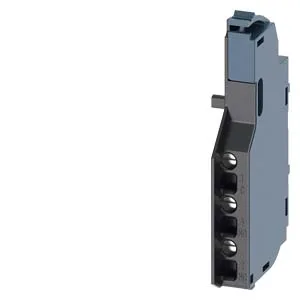
What this auxiliary switch does in the panel
The Siemens 3VA9978-0AA22 is a leading auxiliary switch — a changeover contact block that mounts onto SENTRON 3VA4, 3VA5, and 3VA6 molded-case circuit breakers. Its job is to signal the breaker's ON/OFF position back to a PLC, a status lamp, or a safety circuit, so the control system knows whether the power path is closed or open. The switch contacts are physically linked to the breaker's operating mechanism, so the signal follows the main contacts without relying on a separate sensor. The thermal current rating (Ith) is 6 A, which is the continuous current the switch can carry through its closed contacts without overheating. That's the ceiling for the signal circuit, not the load circuit — you'd wire a 24 VDC PLC input or a 120 VAC indication lamp through these contacts, not a motor or heater. It fits the same environment the 3VA breaker lives in.
Switching capability by load type and voltage
The switch's real-world capability depends on the load type and control voltage. For solenoid and contactor coils (AC-15), the rating drops to 3 A across the same voltage range — the inrush current of an inductive coil is what limits the contact life, not the steady-state current. On DC circuits, the ratings are more voltage-sensitive because DC arcs are harder to extinguish. At 24 V DC, the switch handles 4 A for resistive loads (DC-12) and 0.8 A for inductive loads (DC-13). At 48 V DC, those numbers drop to 2 A and 0.4 A respectively. At 110 V DC, the DC-13 rating is just 0.2 A; at 250 V DC, it's 0.1 A. If you're switching a DC solenoid or brake coil at 24 V, keep the coil current under 0.8 A — that's the rating that governs contact life.
Mechanical fit and wiring
This is a leading auxiliary switch with changeover (HQ) contacts in a 7 mm-wide format. It snaps onto the left side of the 3VA4/5/6 breaker frame. The stripped length for wiring is 15 mm (0.6 in), which is standard for spring-cage or screw terminals on SENTRON accessories. The switch's operating time relative to the main contacts is 20 ms — it signals the breaker position within one AC cycle. That's fast enough for most PLC scan cycles, but if you need near-instantaneous feedback for a safety-rated circuit, verify the response time against your safety relay's requirements.