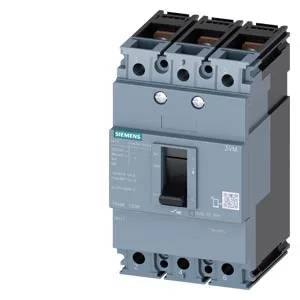
Its 630 A maximum rating and 3-pole construction suit it for main feeder or large sub-feed applications where a single device must handle high continuous current and interrupt substantial fault energy. The TM210 overcurrent release combines a thermal element for overload protection and a magnetic element for short-circuit response — a standard thermal-magnetic design that requires no external control power. At 240 V the interrupting capacity reaches 53 kA; at 415 V it is 32 kA, dropping to 14 kA at 440 V and 8 kA at 500 V.
Above that the continuous current must be reduced: 62 A at 55 °C, 61 A at 60 °C, 60 A at 65 °C, and 58 A at 70 °C. For a panel that runs warm — say 55 °C inside the enclosure — the usable rating drops to 62 A, not the 63 A on the nameplate. This derating curve is the figure a site electrical engineer checks when sizing the breaker for a known enclosure temperature.
The 3-pole width of 76.2 mm (3 inches) is the standard MCCB footprint for this class — it occupies the same panel cutout as other 3-pole SENTRON breakers. Depth of 70 mm means it projects less than 3 inches from the mounting surface, which matters when the enclosure back-panel clearance is tight.