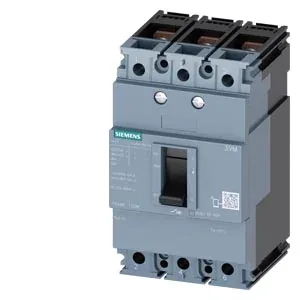
Its 80 A continuous current at 40 °C is the figure that governs the main feeder or branch circuit it protects — derate that number as ambient climbs: 78 A at 55 °C, 75 A at 65 °C, 74 A at 70 °C. The TM210 thermal-magnetic release handles overloads with a fixed thermal curve and magnetic short-circuit pickup, so the breaker is sized for the cable ampacity and load type, not adjustable. Breaking capacity is where this part earns its panel space: 121 kA at 240 V AC, 76 kA at 415 V, 40 kA at 440 V, and 12 kA at 500 V.
Deployment context
The 3VM1080-4ED32-0AA0 is a panel-mounted MCCB for distribution or branch protection in industrial switchboards and control panels. Dimensions — 130 mm height, 76.2 mm width, 70 mm depth — fit standard 3-pole MCCB cutouts. Maximum power loss of 26 W is the heat this breaker dumps into the enclosure at full load. For a panel with multiple breakers side-by-side, that heat adds up — factor it into the thermal budget rather than assuming zero dissipation.
What it does not have — and why that matters
This is a bare-bones thermal-magnetic MCCB — it opens on overcurrent and short-circuit, nothing else. If the application requires remote trip, ground-fault protection, or status feedback, you need a different variant with those accessories built in or added externally.