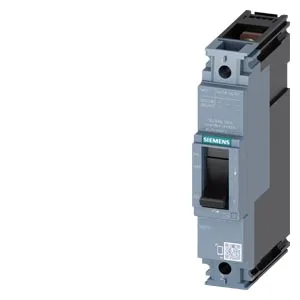
It's a 3-pole unit rated 20 A continuous at 40 °C, with an adjustable overload protection Ir from 14 A to 20 A and a fixed short-circuit protection Ii of 16 × In (320 A). The frame is sized for up to 160 A, so this 20 A breaker sits in a physically larger housing that handles the high interrupting ratings. The headline here is the interrupting capacity: 121 kA at 240 V AC, 76 kA at 415 V AC, 53 kA at 440 V AC, and still 11.9 kA at 500 V AC. The 76 kA at 415 V is the rating most often cited for European 400 V networks; the 121 kA at 240 V covers North American 240/120 V split-phase or 240 V delta services. It's a straightforward line-protection breaker: feed it, protect the cable, move on.
This is a front-connected breaker with box terminals for the main circuit — standard for panelboard or switchboard mounting. No auxiliary contacts come with this unit (0 CO contacts), and the neutral conductor is not upgradeable or retrofittable. If you need alarm or trip-indication signals, you'll need an external auxiliary switch block — verify compatibility with the 3VM frame.
If you're comparing against the 3VA1020-3ED36-0AA0 (the 3VA series successor), note that the 3VM is the IEC-focused value line — same frame sizes, similar breaking capacities, but the 3VA adds more accessory options and a wider adjustment range. The 3VM1120-4EE36-0AA2 will physically fit a panel designed for the 3VA1020-3ED36-0AA0 (same 3-pole footprint, same box-terminal layout), but the release characteristics differ: the 3VM uses the TM220 with fixed Ii = 16 × In, while the 3VA's release may have a different adjustment band. Check your coordination study before swapping.