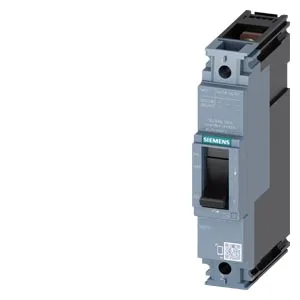
For a 415 V panel with a prospective fault current up to 25 kA, this breaker holds its integrity; above that, you need a higher-capacity frame or a current-limiting upstream device. The 3-pole construction suits three-phase line protection. Overload protection is set via the TM220 thermal-magnetic trip unit with Ir adjustable from 14 A to 20 A. That means the continuous current rating is not fixed at 20 A — you dial in the actual load current within that band, which gives flexibility if the connected load draws, say, 16 A or 18 A. Short-circuit protection Ii is fixed at 16 × In, so at the 20 A setting the magnetic trip fires at 320 A; at the 14 A setting it fires at 224 A. This is a line-protection characteristic, not a motor-protection curve — the magnetic pickup is higher than a typical motor-protective device, so it is sized for feeder or distribution duty, not for direct motor starting. The IEC frame 160 designation means the breaker's mechanical frame is rated for continuous currents up to 160 A, but this specific variant is fitted with a 20 A trip unit. The frame size governs the physical footprint and bus-bar connection pattern — all frame-160 breakers share the same mounting and terminal arrangement, so a panel layout designed for a 160 A frame accepts this 20 A unit without re-drilling.
This breaker is a panel-mounted IEC molded-case circuit breaker for distribution and feeder protection in industrial control panels, switchboards, and sub-distribution boards. The terminal connection type is suitable for bus-bar or cable lug termination in a standard enclosure.