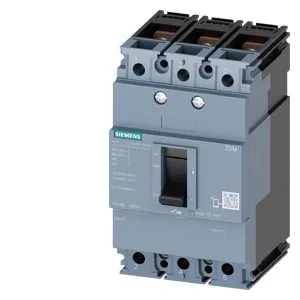
It carries a continuous 32 A at 40-50 °C, and the TM210 thermal-magnetic trip unit handles the overcurrent sensing without any electronic frills.
Interrupting capacity — the real story
Where this breaker earns its keep is the interrupting capacity. At 240 VAC it clears 187 kA symmetrical — that's a monster fault level, typical for a main or large feeder in an industrial plant. At 415 V it's still 121 kA, at 440 V it drops to 76 kA, and at 500 V it's 17 kA. That steep falloff above 440 V is normal for a compact MCCB; the arc extinction physics just can't keep up at higher voltages without a bigger frame. For a 480 V panel you're still fine at 76 kA, but at 600 V class you'd want to check the system fault current against that 17 kA number.
Rated current holds flat at 32 A from 40 °C up to 50 °C, then starts a gentle taper: 31 A at 55-60 °C, 30 A at 65-70 °C. That's a shallow derating curve — you don't lose much headroom even in a hot enclosure. The breaker measures 130 mm tall, 76.2 mm wide, and 70 mm deep, so it fits a standard 3-pole MCCB footprint on the DIN rail or panel-mount plate. Power loss is 11 W at rated load — negligible for ventilation planning.