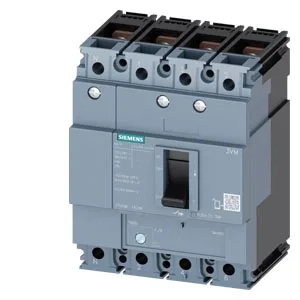
Rated continuous current Iu is 16 A, and it holds that rating across ambient temperatures up to 55 °C — at 60 °C it derates to 15 A, same at 65 °C and 70 °C. Breaking capacity is the headline: 121 kA at 240 V AC, 76 kA at 415 V, 53 kA at 440 V, and 11.9 kA at 500 V. Those numbers tell you this breaker can sit upstream of a high-fault distribution board and still clear a bolted fault without welding its contacts — the 121 kA at 240 V is typical for US 120/240 V split-phase service entrance duty, while the 76 kA at 415 V covers European industrial grids.
The 3VM1196-4GE42-0AA0 measures 101.6 mm wide, 130 mm tall, and 70 mm deep. That 4-inch width matches the standard Siemens 4-pole MCCB footprint — it occupies the same panel cutout as the 3VA equivalent, so a panel designed around the 3VA1020-3ED36-0AA0 will accept this breaker without re-drilling or bus-bar rework. No communication module, no motor drive option: this is a straight thermal-magnetic breaker with no auxiliary electronics. The TM220 release is fixed (non-adjustable), so the 16 A setting is what you get — verify your load current before committing the BOM line.
Coordination and selectivity notes
The TM220 release's thermal curve is designed to coordinate with downstream miniature circuit breakers (MCBs) up to about 16 A — typical for a lighting or receptacle sub-panel. At 500 V, the breaking capacity drops to 11.9 kA, so if you are feeding a 480 V motor control center with a high available fault current, verify the SCCR of the downstream starters. The 690 V rated insulation voltage (Ui) means the internal clearances and creepage are sized for 600 V class systems, which covers North American 480 V and European 400 V grids comfortably.