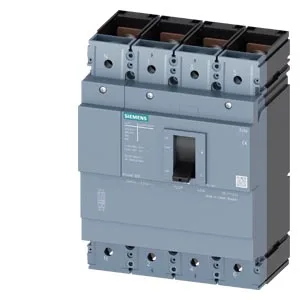
The Siemens SENTRON 3VM1463-5ED42-0AA0 is a 4-pole molded case circuit breaker (MCCB) carrying a continuous current rating of 630 A at 40 °C, with the same rating held up through 50 °C. Above that it derates smoothly: 618 A at 55 °C, 607 A at 60 °C, 595 A at 65 °C, and 583 A at 70 °C. That thermal curve means you can push it into a warm enclosure without losing capacity until you cross 50 °C — a real advantage in a packed panel or near a motor drive. It's fitted with a TM210 thermal-magnetic trip unit — fixed thermal and magnetic settings, no electronic adjustment. The adjustable short-circuit pickup (li) maxes at 5 040 A, which gives some field flexibility for coordinating with downstream feeders.
Breaking capacity — what it can interrupt
The interrupting ratings span the common industrial voltages: 187 kA at 240 V AC, 121 kA at 415 V and 440 V AC, and 76 kA at 500 V AC.
The product lifecycle status is listed as current production, so this isn't an obsolete or end-of-life part. For a BOM line that needs the 630 A 4-pole footprint with a TM210 release, this is the active catalog number.