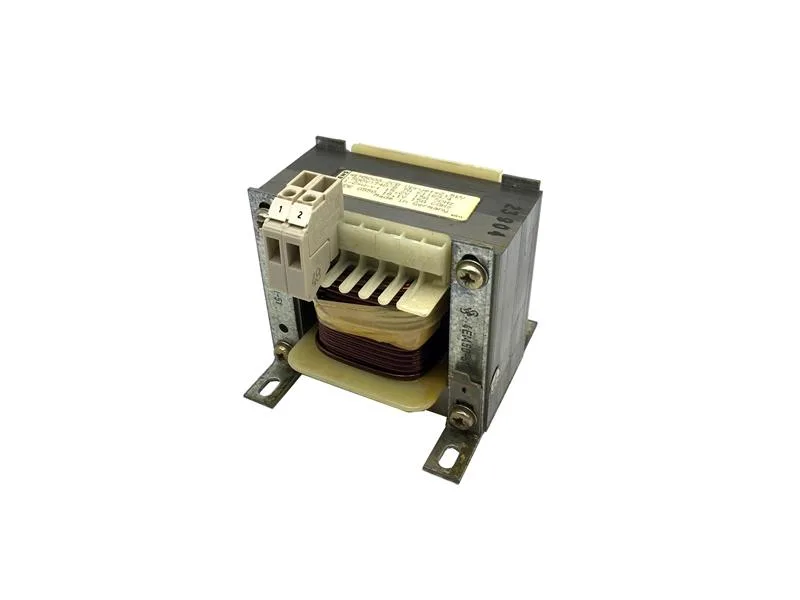
The Siemens SIDAC 4EM5000-1CB00 is a single-phase DC smoothing choke — a Glaettungsdrossel in the original designation — built to sit in the DC link of a drive or power supply and knock the ripple off the bus voltage. Rated for 600 V DC and 1.9 A maximum (1.71 A continuous), with 0.3 H of inductance and a 20 W coil loss at rated load, it's sized for a modest DC bus where you need to keep the current waveform clean enough for downstream electronics or to meet conducted-emission limits. The 50 Hz operating frequency tells you it was designed for a line-commutated rectifier front end, not a high-frequency switcher. IP00 means it's an open-frame component — no enclosure, no finger-safe guarding. The screw-type and tab terminals accept power wiring directly; you'll land the DC bus cables on the M6-ish studs or the 6.3 mm Faston tabs, depending on what your panel builder prefers. Thermal class B (130 °C) per IEC 60085 means the winding insulation holds up to that hot-spot temperature, which is standard for a choke running at 40 °C ambient and 20 W self-heat.
The 1.9 A maximum and 1.71 A rated current are DC values — this choke saturates on DC current, so the inductance (0.3 H) holds only up to that continuous current. Push it past 1.9 A and the core saturates, inductance drops, and you lose the smoothing effect. The 600 V DC rating is the insulation voltage between winding and core; it's not a working voltage for the DC bus — you'd typically run this at 400–500 V DC bus from a three-phase rectifier, leaving headroom. The 0.54 W energy content is the stored magnetic energy at rated current, a number the panel designer uses for sizing discharge resistors or snubbers if the bus needs to be bled down quickly. Dimensions are 0.115 m deep, 0.097 m wide, 0.111 m high — call it 115 × 97 × 111 mm. That's a compact footprint for a 0.3 H / 1.9 A choke; it'll fit on a standard DIN-rail mounting plate or a sub-panel in a small drive cabinet. The screw/tab terminals accept up to maybe 4–6 mm² wire, typical for the current level. No parallel-winding option — it's a single winding, no taps, no series/parallel reconfiguration.