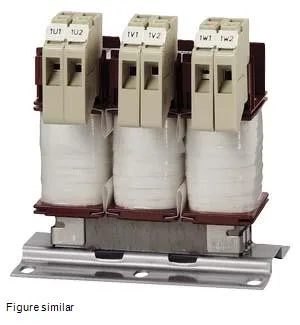
The Siemens SIDAC 4EP3800-4US00 is a 3-phase output reactor rated 10.2 A maximum AC at 120 Hz, with a rated inductance of 0.0012 H (1.2 mH). It's built for 460 V AC line voltage and carries a 40 °C ambient temperature rating with thermal class B insulation per IEC 60085.
The 10.2 A maximum AC current at 120 Hz is the thermal limit (Ith max) — the reactor can carry that continuously without exceeding the temperature rise allowed by thermal class B. The 3 000 Hz rated switching frequency tells you this reactor is designed for PWM inverter outputs — it's meant to sit between a VFD and the motor to limit dv/dt and reduce bearing currents. Power loss splits into 49.6 W in the coil (copper losses) and 29.4 W in the iron core (hysteresis and eddy current losses), totaling roughly 79 W at full load. That heat has to be dissipated inside the panel — account for it in your thermal budget. The screw-type and tab terminals accept standard ring lugs or fork terminals for the main circuit wiring. No special tooling needed, but the tab option is useful for bus-bar connections in high-density cabinets.
Where this class of part is used
Output reactors (also called motor chokes or load reactors) are installed on the output of variable-frequency drives to protect the motor windings from voltage spikes caused by long cable runs or fast-switching IGBTs. They also reduce common-mode currents that can trip upstream RCDs. This 3-phase unit is sized for small to mid-range drives — think conveyor motors, pump drives, fan applications in the 3–7 kW range depending on the drive's output current.
Compliance documentation (RoHS, REACH) is standard for Siemens industrial components — available on request with the RFQ.