What this choke does in a drive panel
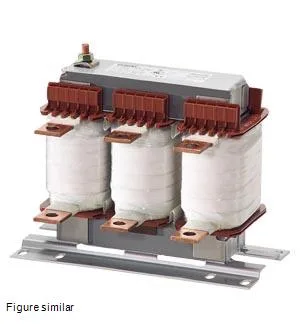
The Siemens 4EP3900-2DS00 is a three-phase commutating choke — a line reactor — designed to sit between a converter (VFD) and the AC mains or motor. Its job is to limit current rise during commutation, reduce harmonic distortion, and protect the converter's DC bus capacitors from repetitive current spikes. Rated 63A AC continuous at 400V, 50Hz, with an inductance of 0.35 mH and a relative inductive voltage drop of 4% at rated current, it's sized for a 3-phase drive system pulling up to that current. The IP00 rating means it's an open-frame component — no enclosure — so it's meant to live inside a panel, not out on the plant floor where grease and coolant fly.
The 63A AC rated current is the continuous thermal limit at 40°C ambient — derate if your panel runs hotter. The peak current of 79A tells you the short-duration surge it can handle without saturating the core, which matters during motor start or a fault event. The 0.35 mH inductance and 4% voltage drop define how much line impedance it adds: enough to smooth commutation notches without dropping excessive voltage under load. Power loss breaks into 70.6W in the coil and 19.1W in the iron core — total about 90W of heat to vent inside the panel. Thermal class B per IEC 60085 means the insulation system handles 130°C hot-spot temperature, standard for industrial chokes. The flat-type terminals accept bus bar or lug connections; no screw-clamp wiring.
The choke measures 0.219m wide by 0.179m tall by 0.123m deep — about 8.6 x 7.0 x 4.8 inches. No DIN rail clip; it's a bolt-down component. Plan for the flat-type terminal connections — these are bus-bar style lugs, not ring terminals or cage clamps. The IP00 open frame means no drip shield or finger guard, so mount it where maintenance hands and dropped tools can't contact live bus bars. Keep clearance around it for the 90W heat dissipation; don't bury it against the backplate or above heat-sensitive electronics.