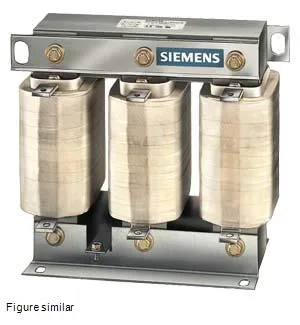
Mains choke for VFD input conditioning
The Siemens 4EP4000-2CK00 is a three-phase mains choke (Netzdrossel f. FU) designed for the input side of frequency converters. It carries a rated current of 78.3 A with a maximum of 87 A at 60 Hz, and an inductance of 0.17 mH. The 2% relative inductive voltage drop means it smooths line harmonics and limits inrush without dropping excessive voltage under load — a common spec for VFD input reactors that keeps the DC bus stable. The IP00 open-frame construction means it mounts inside a cabinet — no washdown rating, no outdoor exposure.
The 78.3 A rated current (87 A maximum) sets the continuous load the choke can carry without saturating the core. Match this to the drive's input current rating — a 75 kW drive at 400 V typically draws around 130 A, so this choke suits a smaller drive (roughly 37–45 kW range) or a derated application. The 0.17 mH inductance value determines the harmonic attenuation: lower inductance gives less filtering but also less voltage drop. At 2% drop it's a standard impedance reactor, not a heavy-duty harmonic filter. Thermal class B per IEC 60085 means the insulation system withstands 130 °C hot-spot temperature. The combined coil loss (55 W) and iron-core loss (38 W) total 93 W dissipated as heat inside the cabinet — factor that into your enclosure ventilation. The ambient temperature rating of 50 °C is the maximum air temperature around the choke; derate current above that. Termination is via flat-type connectors (Type of electrical connection for main current circuit: flat connector). These are blade-style lugs, not ring terminals or screw clamps — verify your cable lug compatibility before wiring.
Integration notes
Mounting dimensions: 0.219 m wide, 0.179 m tall, 0.143 m deep. The open-frame IP00 construction requires a clean, dry cabinet environment — no washdown zones, no dust-laden air. Plan for the 93 W total heat dissipation in your thermal budget. Flat-type terminals expect matching blade connectors; pre-crimp or order the correct mating lugs.