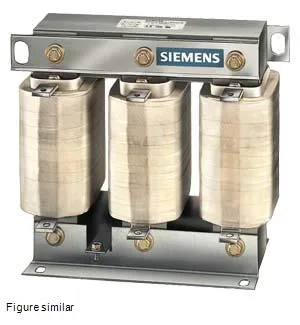
It's rated for 500 V AC, 50 Hz, with a maximum continuous current of 63 A and a rated current of 56.7 A. The inductance is 0.58 mH, and the relative inductive voltage drop is 4% at rated current, frequency, and voltage. This is the component that limits di/dt and reduces harmonic distortion on the line side of a variable-frequency drive or DC drive converter.
The 63 A maximum current and 56.7 A rated current define the thermal capacity under continuous load. For a 400 V class drive, this choke typically pairs with a 30–37 kW motor load, but the exact sizing depends on the drive's input current and the required impedance. The 4% voltage drop is the design target — it provides enough inductance to smooth commutation notches without dropping excessive voltage across the choke at full load. The 0.58 mH inductance and 50 Hz rating are the operating point. If the converter runs at 60 Hz, the impedance increases proportionally, which shifts the voltage drop and may reduce the effective current rating — derate accordingly. The IP00 enclosure means it's an open-frame component for panel mounting only; no washdown or dust protection. Flat-type terminals accept busbar or cable lug connections, not spring-cage or screw-clamp. Power loss splits into 80 W in the coil and 35 W in the iron core, totaling 115 W at rated conditions. That heat must be managed inside the panel — forced ventilation or a larger enclosure if other heat sources are nearby. Thermal class B per IEC 60085 means the insulation system is rated for a 130 °C maximum hot-spot temperature, which is standard for this class of reactor.
Mounting dimensions: depth 0.143 m, width 0.219 m, height 0.179 m. This is a panel-mount reactor, not DIN-rail. The flat-type terminals are the main circuit connection; verify the busbar or cable lug hole size against your wiring before ordering. The IP00 protection class means the choke must be installed inside a grounded enclosure with appropriate clearance to live parts — it is not touch-safe on its own.