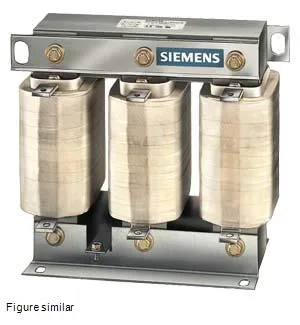
The Siemens 4EP4005-8MS00 is a 3-phase filter reactor rated 10 kvar at 400 V, 50 Hz, designed to attenuate harmonic currents on the line side of variable-frequency drives and other non-linear loads. It is built to EN 61558-2-20, the standard for chokes and reactors, and comes with free conductor ends for direct panel wiring — no terminal block on the reactor itself, so plan your gland plate and cable entry accordingly.
The 10 kvar rating at 400 V tells you the reactive power the reactor handles at rated voltage and frequency. For a 400 V drive system at 50 Hz, this reactor will present the designed impedance to limit harmonic distortion — typically used to meet IEEE 519 or similar grid-code harmonic limits. The 14 % impedance (P(%):14) means the reactor's voltage drop at rated current is 14 % of the line voltage, which is a standard value for input line reactors in industrial drive applications. The 134 Hz resonant frequency (FRES(HZ):134) is the point where the reactor and system capacitance could resonate; stay clear of that frequency band in your system design. The ripple voltage percentages (RIPPLE VOLT. (%):106 /0 /6 /5) describe the voltage distortion across the reactor under specific test conditions — these are design verification values, not selection parameters. The 40 /B temperature class (TA/ISOKL:40 /B) indicates a 40 °C ambient rating with Class B insulation (130 °C max hot-spot), so derate if your cabinet ambient exceeds 40 °C.
Terminals are free conductor ends — stripped cable tails, no lugs or terminals pre-fitted. You will need to terminate with ring or fork terminals sized for your cable and the reactor's lug aperture. The IP00 rating means the reactor core and windings are exposed; mount it inside a clean, dry enclosure with at least 100 mm clearance around the core for airflow. Do not mount directly above heat-generating components like braking resistors or drive heat sinks.