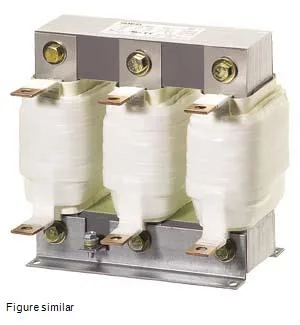
What this output reactor does in your drive line
The Siemens SIDAC 4EU2432-0EC00-0AA0 is a 3-phase output reactor rated for a maximum continuous current of 300 A and a switching frequency of 4 600 Hz. It sits between the drive output and the motor cable, limiting the rate of voltage rise (dV/dt) and reducing capacitive charging currents in long cable runs. Connection is via flat-type terminals, so plan for busbar or lug-style wiring rather than cage clamps.
The 300 A maximum current sets the motor-side thermal limit. This reactor is sized for a drive feeding a motor drawing up to that full-load current; oversizing by more than one frame risks poor high-frequency attenuation. The rated switching frequency of 4 600 Hz matches IGBT drives running at 4–6 kHz carrier — common in general-purpose VFDs. If your drive uses a lower carrier (2 kHz or below), the reactor still works but the core loss and temperature rise will be lower than the design point. The 0.012 mH inductance is a low value, typical of reactors intended for dV/dt mitigation rather than heavy harmonic filtering. Power loss splits into 110 W coil loss and 55 W iron-core loss at the rated ambient of 45 °C, thermal class H — the winding insulation handles a 180 °C hot-spot, so it can run hot in a crowded cabinet as long as airflow is not blocked.
At 0.22 m wide, 0.21 m tall, and 0.13 m deep, the reactor occupies about the space of a large contactor. The flat-type terminals accept busbar or crimp lugs — not screw-clamp or spring-cage wire ends. Mount it on a flat panel or a subplate inside the cabinet; there is no DIN-rail clip. The IP00 rating means no ingress protection — keep it behind a locked door, away from dust and dripping water. Ambient temperature must not exceed 45 °C for full-rated current; derate above that per the thermal class H curve.