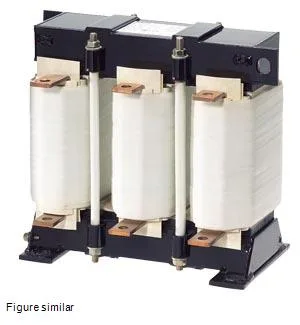
It sits between the supply and the drive, smoothing current harmonics and limiting inrush — which keeps the drive's DC bus from seeing the full force of the line and reduces reflected-wave stress on motor windings. Rated for 690 V AC at 50 Hz, it carries a maximum AC current of 91 A and a rated operational current of 81.9 A. The IP00 rating means it's an open-frame component — no enclosure. It's meant for inside a panel where it gets bolted down and wired in. The flat-type terminals accept busbar or large-gauge lug connections, not spring-cage or screw-clamp terminals.
Thermal and lifecycle reality
This choke is built with Class H insulation per IEC 60085, rated for a 40 °C ambient. Class H means the winding insulation can handle a 180 °C hot-spot temperature — that's a lot of headroom above the 40 °C ambient, so it runs cool even under continuous full load. The total power loss splits into 125 W in the coil and 28 W in the iron core; that heat has to get out of the panel, so factor it into your enclosure's thermal budget.
Dimensions are 0.225 m wide, 0.21 m tall, and 0.147 m deep. That's a substantial chunk of iron — about the size of a small shoebox. It's not a DIN-rail mount; it bolts to the backplane. Leave clearance around it for airflow and for the flat-type terminal connections. The flat-type terminals are the main connection point. They're designed for busbar or crimp lugs — not for ring terminals or wire ferrules. If your panel uses screw-clamp terminal blocks on the drive input, you'll need a short busbar section or a lug-to-ferrule adapter to land the choke.