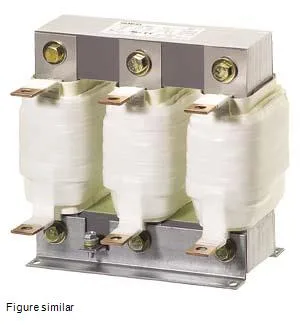
The Siemens SIDAC 4EU2532-0MF08-0AA0 is a 3-phase filter reactor, also called a line reactor or input choke, sized for 220 V AC mains at 50 Hz. The 0.46 mH inductance and 5.67% relative throttling factor mean it's tuned to knock down harmonic content and limit inrush on the line side of a variable-frequency drive or a power-correction bank. The 210 Hz resonant frequency tells you where the attenuation peak sits — it's not a random value, it's designed to suppress the 5th harmonic (250 Hz) neighborhood typical of 6-pulse rectifiers. This part lands in a panel or enclosure — it's IP00, meaning no built-in ingress protection. Thermal class H (180 °C insulation) means it can run hot without cooking the windings, which is common for reactors packed tight in a drive lineup.
The 60.2 A rated current at 220 V AC, 3-phase, tells you this reactor is sized for a drive or load drawing roughly that continuous current. The 67 A maximum is the short-term overload ceiling — don't plan on running at 67 A steady-state. The 5.67% throttling factor is the voltage drop at rated current, so it's a moderate-impedance reactor — enough to clean up harmonics and limit fault current without dropping excessive voltage across the choke. The 20 kvar reactive power rating is the bank size this reactor is meant to work with, typical for power-factor correction or harmonic filtering applications. The 0.46 mH inductance and 210 Hz resonant frequency are paired — the reactor is designed to resonate with the system capacitance at that frequency, steering the attenuation band. The 50 Hz operating frequency is standard for European and most Asian mains; if your line is 60 Hz, the resonant behavior shifts, so verify the harmonic profile before swapping in. Dimensions are 0.225 m wide by 0.21 m tall by 0.16 m deep — roughly 9 by 8 by 6 inches. That's a compact footprint for a 60 A 3-phase reactor, but IP00 means it needs cabinet clearance for airflow and creepage distances. The flat connector / screw-type terminals accept standard bus-bar or lug terminations, common in power distribution panels.