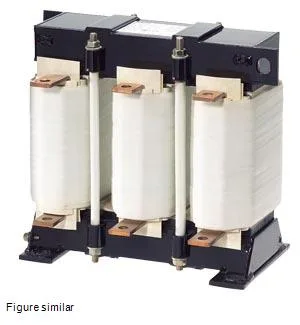
It smooths current draw, reduces harmonic distortion, and limits inrush — the kind of component that keeps a drive from tripping the upstream breaker on startup or injecting noise back onto the plant grid. Rated at 199 A continuous with a 221 A maximum. The 4% relative inductive voltage drop is standard for line reactors in this class. The 0.133 mH inductance is the value that governs the choke's filtering performance; paired with the 4% drop, it tells you this is a general-purpose input reactor, not a high-impedance or DC-link variant.
Where it fits — panel and environment
IP00 means it's an open-frame component — no enclosure, no gaskets. It mounts inside a cabinet, not on the wall or in a washdown zone. The flat-type terminals accept busbar or large-gauge cable lugs, which is typical for a choke this size. Dimensions are 0.27 m wide by 0.248 m tall by 0.208 m deep — roughly the footprint of a large contactor or a small drive, so plan for a dedicated mounting plate or DIN-rail adapter if the cabinet layout is tight. Rated ambient temperature is 45 °C, which covers most ventilated enclosures. Thermal class H (180 °C insulation system) per IEC 60085 means the coil can handle sustained overloads without degrading — a solid margin for industrial duty where the drive might run at 100% for hours.
The 199 A rated current is the continuous thermal rating at 45 °C ambient. The 221 A maximum is the short-term overload ceiling. Operating voltage is 400/480 V AC, 50/60 Hz. That covers the common industrial voltages in Europe (400 V) and North America (480 V). The choke is a passive component, so it works on either frequency without derating — the inductance value is the same, and the 4% voltage drop scales with frequency. Power loss splits into 160 W in the coil and 97 W in the iron core. Factor this heat into your cabinet thermal budget.