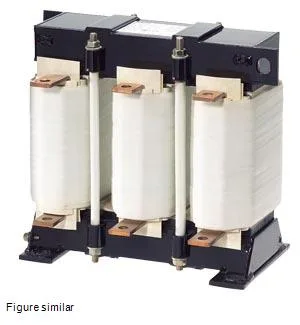
What this choke does in a drive cabinet
It limits current rise and voltage notching from the rectifier, protecting the DC link and downstream IGBTs. Maximum continuous current is 224 A, with a rated value of 201.6 A and a peak current of 394 A — sized for a heavy industrial drive, not a light-duty VFD. Inductance is 0.16 mH, with a relative inductive voltage drop of 4% at rated current and frequency. That 4% figure tells you the choke is designed for a specific impedance match — swapping in a generic reactor with a different voltage drop shifts the commutation notch and can increase DC-link ripple or stress the input bridge. Terminals are flat-type connectors, typical for busbar or cable-lug connections in larger power assemblies.
Thermal class and power loss — what they mean for panel design
Thermal class H per IEC 60085 means the winding insulation can sustain 180 °C hot-spot temperature. That is the highest standard insulation class for dry-type reactors — it survives the heat in a crowded cabinet where ambient hits 40 °C (the rated ambient). Total power loss is 262 W — 167 W in the coil and 95 W in the iron core. That is not trivial; it must be factored into the cabinet's thermal budget. A 262 W continuous heat source in a sealed IP54 enclosure can raise internal temperature by 10–15 °C without forced ventilation. Plan for airflow or derating if the panel runs near the 40 °C ambient limit.