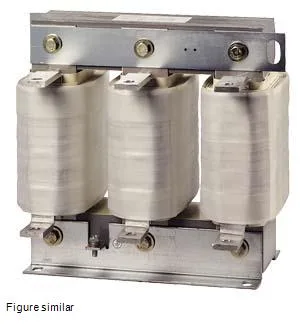
The Siemens 4EU2732-0CE08-1EA0 is a 3-phase filter reactor rated at 50 kVAR reactive power at 525 V, 50 Hz. It's a line-reactor class choke built to EN 61558-2-20 — that's the standard for power transformers and reactors, so you know the insulation and thermal limits are tested to that spec. The IP00 enclosure means it's an open-frame unit for cabinet mounting, not for standalone outdoor use. Terminals are free conductor ends, so you'll land your own cable lugs directly. In a drive or power-correction circuit, a filter reactor like this one sits between the supply and the load to smooth current harmonics, limit inrush, and protect downstream components from line spikes. The 50 kVAR rating at 525 V tells you its reactive power handling — sized for a moderate-to-large drive or a capacitor bank detuning application. The 5.67% impedance (P(%):5,67) is the short-circuit voltage ratio; that's the figure that governs how much fault current the reactor lets through and how well it attenuates harmonics.
The 50 Hz line frequency is fixed — this reactor is wound for 50 Hz operation. If your site runs 60 Hz, the magnetic core saturates differently; you'd need a 60 Hz rated unit. The 525 V nominal voltage means it's designed for 500 V class systems (common in European 400 V networks with 10% overvoltage tolerance). The 210 Hz resonant frequency (FRES(HZ):210) is the self-resonant point of the winding; above that frequency the reactor starts behaving capacitively, so keep your switching harmonics below that for effective filtering. The ripple voltage percentages (110 /0 /6 /5) describe the harmonic spectrum the reactor is tested against — a standard set of distortion levels for line reactor validation. The 40 K temperature rise at rated current (TA/ISOKL:40 /H) is the winding temperature rise above ambient under continuous full-load operation. In a 40 °C cabinet ambient, the winding would reach about 80 °C — well within Class B insulation limits, but check your enclosure ventilation if you're stacking multiple reactors in a tight panel. Free conductor ends mean you need to provide your own ring or fork terminals; no connector blocks are included.