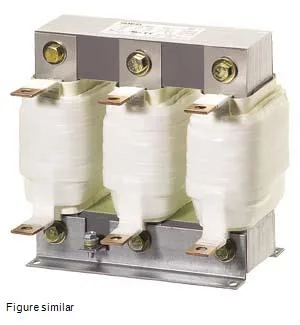
What this output reactor does in a drive line
The Siemens SIDAC 4EU3031-0UA00-0A is a 3-phase output reactor rated for a maximum continuous current of 82 A and a rated frequency of 3 000 Hz, with an inductance of 0.00023 H (0.23 mH). It sits between the variable-frequency drive output and the motor cable to limit the rate of voltage rise (dV/dt) and reduce capacitive charging currents in long cable runs — a common source of nuisance drive trips and motor insulation stress.
The 82 A maximum current is the thermal limit under the rated conditions; the reactor is designed for a motor-side current of 73.8 A in continuous duty, so it matches a drive output stage sized around 75–80 A. The 3 kHz rated frequency is the switching frequency of the drive's IGBTs — not the motor's fundamental frequency — so this reactor is suited for drives running carrier frequencies up to 3 kHz. The 0.23 mH inductance provides enough impedance to limit dV/dt on cable runs typically up to 100–150 m, depending on cable capacitance. Power loss splits between the coil (207 W) and iron core (166 W) for a total of about 373 W at full load; that heat must be managed inside the panel. Thermal class H means the winding insulation can handle a 180 °C hot-spot temperature, giving margin for overload conditions. The flat-type terminals accept bus-bar or large cable lugs — not spring-cage or screw-clamp connectors.
The reactor is built to EN 61558-2-20 and carries UL/CSA recognition. It is rated for a 575 V line voltage and an ambient temperature of 40 °C. The IP00 protection class confirms it is an open-frame component for cabinet mounting — no washdown or dust-tight rating.