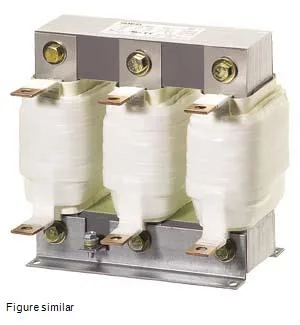
What this output reactor does in the drive circuit
The Siemens SIDAC 4EU3052-0AN10-4BA0 is a three-phase AC output reactor — a series choke placed between a variable-frequency drive and the motor. Its job is to limit the rate of voltage rise (dV/dt) and reduce reflected-wave peaks on long cable runs, protecting the motor winding insulation from premature failure. Rated for a maximum continuous current of 86 A and an inductance of 0.15 mH, it is sized for a motor load drawing up to that current on a 350 V AC line (per the UN1 rating). The reactor is designed for a switching frequency range of 1 kHz to 8 kHz, covering the typical IGBT carrier frequencies used in modern drives.
Below that, the 77 A rated operational current (ILN) is the value used for standard motor sizing. The 40 % impedance (UK) means the reactor's voltage drop at rated current is 40 % of the line voltage, which is a typical figure for output reactors intended to limit motor terminal overvoltage. Flat-type terminals accept busbar or cable lugs for the main circuit connection.
The reactor measures 0.30 m wide by 0.26 m tall by 0.21 m deep — a substantial footprint that requires planning for panel layout and cable entry. The IP00 construction means it must be mounted in a clean, dry enclosure with forced ventilation if the ambient inside the cabinet exceeds 40 °C. Thermal class H insulation gives headroom for overloads, but the reactor itself will dissipate heat proportional to the square of the load current; allow adequate air gap around all sides. The flat-type terminals are intended for bolted connections — torque values per Siemens installation guidelines apply.