What this reactor does for your drive line
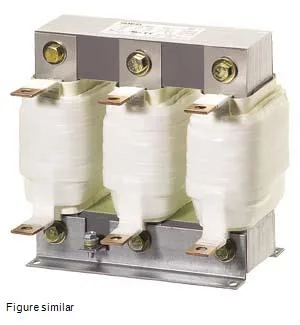
The Siemens 4EU3052-1UB00-0AA0 is a 3-phase mains choke (Netzdrossel f. FU) designed to sit between the supply and a variable frequency drive. Its job is to limit harmonic distortion, reduce peak currents, and protect the drive's DC bus from line-side transients — the kind that trip upstream breakers or cook the input rectifier on a hard start. Rated 225 A continuous with a 250 A maximum, it handles the full-load current of a substantial motor drive without saturating. The 0.15 mH inductance (0.147 mH per the description) gives a 4 % relative inductive voltage drop at rated current and frequency. That 4 % figure is the standard sweet spot for drive input reactors — enough to clean up the line without dropping so much voltage that the drive's DC bus starves under load. At 500 V AC, 50 Hz, this reactor is sized for European-standard industrial mains feeding a 3-phase drive.
Thermal class and power loss — what they mean for panel design
Thermal class H per IEC 60085 means the coil insulation can withstand 180 °C hot-spot temperature continuously. That is a wide safety margin above the 40 °C ambient rating — useful when the reactor is mounted inside a crowded enclosure where airflow is tight. Total power loss is 307 W (220 W coil + 87 W iron core). That is the heat you must vent; a panel with this reactor needs forced ventilation or generous natural convection area to keep the internal rise under control. IP00 protection class means the reactor has no enclosure — it is a bare magnetic assembly intended for mounting inside a locked electrical cabinet. The flat-type terminals accept busbar or cable lugs; plan for a bolted connection on the main circuit path. Dimensions are 0.221 m deep, 0.3 m wide, 0.269 m tall — a compact footprint for a 225 A reactor, but leave clearance for airflow and terminal access on all sides.