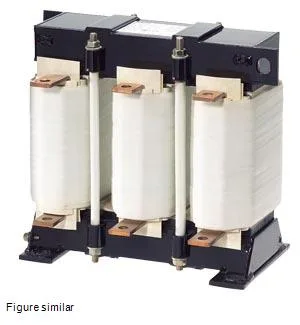
It sits between the AC line and the converter input, limiting current rise rates and reducing harmonic distortion. Rated 560 A AC continuous at 400 V, 50 Hz, with a peak current capacity of 700 A — sized for heavy industrial drive applications where the converter's switching action would otherwise stress upstream components.
The 560 A AC maximum current is the thermal limit at 40 °C ambient — the choke can carry that continuously without exceeding Class H insulation (180 °C hot-spot) per IEC 60085. The 504 A AC rated operational current is the design point for the 4 % inductive voltage drop; at that current the choke drops 4 % of line voltage, which is typical for commutating duty. The 686.2 A DC rated current tells you the DC-link side can handle that level if the choke is used in a DC bus application — though the primary role is AC line side. The 37 µH inductance is the value that limits di/dt during converter commutation. That's a relatively low inductance — this is a commutating choke, not a line filter reactor. It's sized to protect the converter's thyristors or IGBTs from excessive current rise, not to smooth the waveform for the grid. The 293 W coil loss plus 140 W iron core loss total about 433 W of heat to vent; the IP00 enclosure means it's open-frame — must be mounted in a clean, dry cabinet with forced airflow or natural convection clearance.
This choke lands in a drive cabinet, typically bolted to a mounting plate or chassis rail. Dimensions are 0.35 m wide × 0.321 m tall × 0.227 m deep — it's a substantial block, not a DIN-rail component. The main circuit connects via flat-type terminals, which means busbar or heavy cable lugs. No IP rating beyond IP00, so it needs a clean, dry environment inside the enclosure. Thermal class H insulation gives headroom for high-ambient cabinets, but the 40 °C rated ambient is the design point — derate current above that.