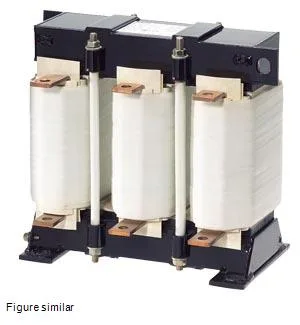
The Siemens 4EU3622-2BA00-0AA0 is a 3-phase commutating choke (also called a line reactor or commutation inductor) designed for use with converters — typically variable-frequency drives, DC drives, or regenerative power supplies. Its job is to limit the rate of current rise (di/dt) during commutation, reduce harmonic distortion, and protect the converter's semiconductor switches from voltage spikes and overcurrents. Rated for 315 A maximum continuous current and 283.5 A nominal, with an inductance of 0.15 mH and a relative inductive voltage drop of 4% at rated conditions, this choke sits between the supply and the converter input or in the DC link, depending on the topology. At 690 V AC operating voltage, that's about 27.6 V drop — well within what most drive input stages tolerate. The 315 A maximum rating means this choke can handle a 315 A continuous load at 50/60 Hz without saturating the core, which is important for drives feeding high-inertia loads like conveyors, crushers, or pumps where inrush can be significant.
Thermal and environmental fit
40 °C ambient, thermal class H insulation. 300 W coil loss, 220 W iron-core loss. Dimensions: 0.227 m depth, 0.35 m width, 0.321 m height. IP00 open-frame; flat-type terminals for main circuit.
The 315 A maximum / 283.5 A rated current at 690 V AC, 3-phase, maps to a drive input current of roughly 315 A RMS. That typically corresponds to a 200–250 kW (270–335 HP) drive at 400 V, or a 350–400 kW (470–540 HP) drive at 690 V, depending on the drive topology and overload profile. The 0.15 mH inductance gives a 4% impedance at 50 Hz — a standard value for input reactors that limit harmonic current to within IEEE 519 guidelines when used with a 6-pulse drive. If your drive is on a weak supply or you're chasing harmonic compliance, this choke is the right tool. The DC-rated current of 386 A is worth noting: if you're using this choke in the DC link of a regenerative drive or a battery charger, the DC current rating is higher than the AC rating because there's no skin effect or AC core loss at DC. That gives you headroom for DC applications — but verify the inductance at DC (it may saturate at a lower current than the AC rating suggests, since the core is gapped for AC operation).