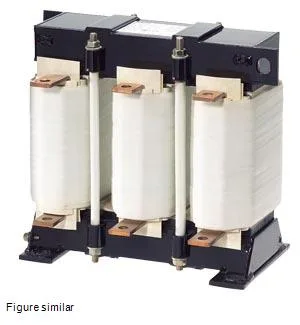
The Siemens 4EU3622-3AA08-1BA0 is a 3-phase commutating choke (also called a line reactor or converter choke) designed to sit between a converter drive and the AC mains. Its job is to limit the rate of rise of current (di/dt) during commutation events, reduce harmonic distortion, and protect the converter's semiconductor devices from voltage spikes and notching on the supply side. The inductance is 0.037 mH (37 µH), which produces a relative inductive voltage drop of 4% at the rated current, frequency, and voltage — a standard impedance value for this class of choke. The 280 W coil power loss plus 195 W iron-core loss means the total heat dissipation is roughly 475 W at full rated load.
Main circuit connections are via flat-type terminals (bus-bar style), not screw clamps or spring cages. That means the mating connectors need to be flat copper bars or lugs sized for the 710 A continuous current. Verify your panel's bus-bar drilling pattern matches the terminal spacing before committing the BOM.
The 710 A maximum is the thermal limit at 40 °C ambient, class H insulation. That's the number to use for bus-bar sizing and upstream breaker coordination. The 639 A rated current is the continuous operating level at which the 4% voltage drop and the published power losses hold — design your cooling and conductor sizing around this figure. The 4% relative inductive voltage drop (Uk) means the choke presents a 4% impedance at rated current. That's typical for line reactors used to limit inrush and harmonic current. If your drive manufacturer specifies a 3% or 5% impedance, this part will work — but check the drive's minimum inductance requirement against the 0.037 mH value.