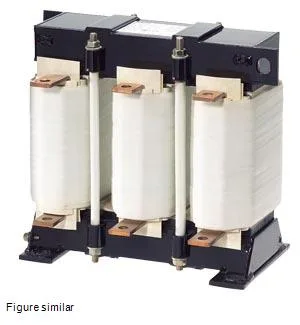
The Siemens 4EU3632-0FL00-0EA0 is a 3-phase filter reactor rated 100 kVAR at 400 V, 50 Hz, with a 5.67% p impedance. It's built to EN 61558-2-20 as a choke, meaning it's designed for harmonic filtering and line conditioning in power distribution — not a general-purpose line reactor for motor drives. The 210 Hz resonant frequency tells you it's tuned to suppress the 5th harmonic (250 Hz on a 50 Hz system) and nearby orders, which is exactly what you need when a six-pulse rectifier is feeding a VFD or UPS bank and you want to keep the grid clean. Out here in the grease, I've seen what happens when you skip the line reactor on a big rectifier — the transformer hums, the capacitor bank runs hot, and you start losing drives to DC-bus ripple. This reactor sits between the supply and the load, soaking up the harmonic current before it gets back to the utility.
The 100 kVAR figure is the reactive power rating at the fundamental frequency — it tells you the reactor's core and winding are sized to handle that continuous VAR load without saturating. The 5.67% p (percent impedance) is the voltage drop across the reactor at rated current; that's a standard value for a detuned filter reactor, giving enough inductance to shift the resonant frequency away from the dominant harmonics. IP00 means it's an open-frame unit — no enclosure, no drip shield — so it goes inside a panel or cabinet where it's protected from dust and moisture. Terminals are free conductor ends, so you'll need to land your cables with lugs or ferrules in the panel.
Integration notes
This is a panel-mount component, not a standalone box. Mount it on a horizontal surface inside the cabinet with adequate ventilation — the 40 °C ambient rating (TA/ISOKL:40 /H) means it's rated for continuous duty at 40 °C, but you'll want airflow if you're running it near that limit. Free conductor ends give you flexibility in wiring, but also mean no built-in terminal block; plan for a junction point in the panel. The 210 Hz resonant frequency is the key parameter for system tuning — verify it doesn't coincide with any other filter stages or capacitor banks on the same bus.