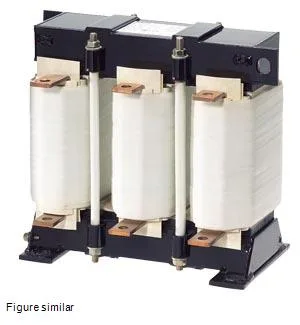
The Siemens SIDAC 4EU3652-0AP00-4BA0 is a 3-phase output reactor rated for 117 A maximum continuous current and an 8 kHz switching frequency. It carries 0.1 mH inductance per phase and is built to thermal Class H (180 °C) per IEC 60085, with a combined copper and iron-core power loss of 400 W at rated load. Rated for 400 V AC line-to-line, this reactor sits between the drive output and the motor leads. Its job is to limit the rate of voltage rise (dV/dt) from the PWM waveform and reduce capacitive coupling currents in long motor cables. The 8 kHz switching frequency matches the typical IGBT carrier frequency of modern variable-frequency drives — if your drive runs a higher carrier (12–16 kHz), the core losses will increase and you may need to derate the current.
For a motor drive application, the motor full-load current should stay at or below this figure. The 0.1 mH inductance is relatively low — typical for reactors sized to handle high currents without excessive voltage drop. At 8 kHz, the impedance per phase is about 5 Ω, which provides moderate dV/dt suppression for cable runs up to roughly 100 m. For longer cable runs or higher carrier frequencies, a higher inductance value would be needed. The IP00 protection class means the reactor has no enclosure — the windings and core are exposed. The flat-type terminals accept busbar or large cable lugs; plan for adequate clearance around the terminals per IEC 61439.
The SIDAC series covers a range of output reactors, and this 117 A, 0.1 mH variant occupies a specific slot in that lineup — sized for mid-power drives (roughly 55–75 kW depending on motor current). If your BOM calls for this exact order code, the ratings confirm fit: 3-phase, 400 V, 8 kHz switching frequency, flat terminals. No substitution guesswork needed.