What this output reactor does on your drive line
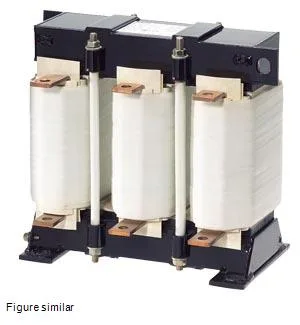
The Siemens SIDAC 4EU3652-0AS00-4BA0 is a 3-phase output reactor rated for 80 A maximum continuous current and a switching frequency of 8 kHz, with an inductance of 0.3 mH. It sits between the VFD output and the motor leads to limit the rate of voltage rise (dV/dt) and reduce reflected-wave stress on motor insulation — a common fix on long cable runs or when feeding a motor that wasn't designed for IGBT switching edges. The 0.3 mH inductance is sized for the 8 kHz carrier, so it knocks down the high-frequency content without dropping too much voltage at line frequency. Rated ambient is 40 °C, and the thermal class H winding (180 °C hot-spot) gives it headroom in a crowded cabinet. The IP00 enclosure means it's open-frame — plan for panel clearance and keep conductive debris off the windings. Terminals are flat-type connectors, so you'll need ring or fork lugs, not spring-cage.
The 80 A maximum is the thermal current rating (Ith) at 40 °C ambient. For a drive feeding a motor, you'd typically size this so the motor FLA stays under 80 A — it's not a short-time overload rating. The 8 kHz switching frequency matches the carrier of most modern IGBT drives; if your drive runs a different carrier (say 4 kHz or 12 kHz), the reactor still works but the effective inductance at that frequency shifts slightly. The 0.3 mH value is a common sweet spot for cable runs up to about 100 m on 400 V class drives. Physical footprint: 0.35 m wide, 0.32 m tall, 0.22 m deep. That's a substantial block — roughly 14 by 13 by 9 inches. Make sure the panel backplate or mounting rail has the clear space before you cut the gland plate. The flat-type terminals need access for a wrench; don't bury it against a sidewall.
Where it goes — deployment context
This output reactor is a panel-mount component — no DIN rail clip, no chassis tabs. It's designed to be bolted to a backplate or mounted on its own bracket inside the enclosure. Typical install: between the drive output terminals and the motor cable gland plate, as close to the drive as cable bending radius allows.