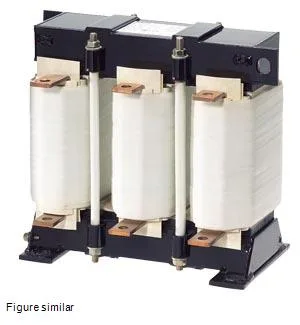
What this output reactor does on a VFD line
The Siemens SIDAC 4EU3652-0BH00-1BA0 is a 3-phase output reactor (output choke) that sits between a variable-frequency drive and the motor. Its job is to limit the rate of voltage rise (dV/dt) and reduce reflected-wave peaks that can damage motor winding insulation on long cable runs. Rated for a maximum continuous current of 116 A and a switching frequency of 8 kHz, it handles the high-frequency PWM content from modern IGBT-based drives. The 0.3 mH inductance and 50% impedance (UK) are sized for typical 400 VAC drive outputs, smoothing the motor-terminal voltage to keep peak spikes within the insulation system's capability. This is the kind of part a drive panel needs when the motor cable exceeds about 50 meters — without it, you risk premature motor failure from corona discharge.
Thermal and mounting realities for the panel builder
Total power loss is 490 W (230 W coil + 260 W iron core) at rated load and 40 °C ambient. That's significant heat to manage — this reactor needs forced ventilation or generous free air space inside the enclosure; don't bury it against other heat sources. Class H insulation (180 °C rated) gives headroom for high ambient or overload conditions, but the enclosure still has to move that heat out. The IP00 rating means it's an open-frame component — no finger-safe enclosure, no drip protection. It belongs inside a locked cabinet, not on the machine exterior. Dimensions are 0.35 m wide by 0.32 m tall by 0.22 m deep, so it takes up about the footprint of a small pizza box.