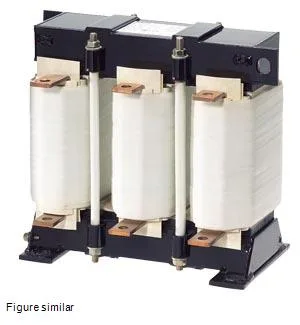
The Siemens 4EU3921-2AA00-0A is a 3-phase commutating choke for converter applications, rated 500V AC with a maximum current of 630A and a continuous rated current of 567A at 50Hz. The 0.000055H inductance and 4% relative inductive voltage drop are sized to limit di/dt and reduce commutation notches on the line side of a 6-pulse or 12-pulse converter bridge — a common fit for medium-voltage drive input sections or DC-link smoothing in heavy industrial converters.
The 567A rated current (630A maximum) at 500V AC, 50Hz tells you this choke is sized for a converter input drawing around 315 kW at 500V (assuming typical power factor and efficiency). The 772A DC rated value confirms it can also sit in the DC link of a 6-pulse drive where the DC current is higher than the AC line current. The 4% voltage drop is the impedance at rated current — that's the commutation notch suppression you get; if your system needs tighter harmonic mitigation, you'd look for a higher impedance (typically 6-8% for 12-pulse). Thermal class H means the winding insulation can handle a 180°C hot-spot temperature. That's a step above the common class F (155°C) and tells you this choke is designed for continuous full-load operation in a 40°C ambient without derating — useful in a crowded converter cabinet where airflow is marginal. The total power loss of 600W (380W coil + 220W iron core,) is the heat you need to vent; at IP00, there's no enclosure, so it relies on the cabinet's forced-air or natural convection.
This class of part — a commutating choke — sits between the AC line and the input of a thyristor or diode rectifier in a variable-speed drive, DC drive, or UPS. Its job is to limit the rate of current rise (di/dt) during commutation, which reduces voltage notches on the supply and lowers harmonic distortion. In a typical 500V drive cabinet, you'd bolt this choke to the chassis or mount it on a separate sub-panel; the flat-type terminals accept busbar or large cable lugs, not DIN-rail spring clamps.