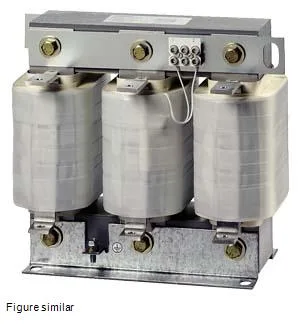
The 4EU4321-0AX00-0A is a three-phase commutating choke for converter applications, rated 575 V AC at 50 Hz. It carries a maximum continuous current of 1 040 A and a rated current of 936 A, with a peak current capability of 1 300 A. The 0.00003 H inductance and 4% relative inductive voltage drop are sized for line-side or DC-link commutation in high-power drives and rectifier stacks.
The 1 040 A maximum is the thermal limit at 50 Hz — the choke can carry that continuously at 40 °C ambient without exceeding class H insulation temperature rise. The 936 A rated value is the design-point current for the 4% voltage drop figure; if your converter draws more than that at full load, the choke's impedance will drop more voltage than the 4% spec, which shifts the DC-link voltage available to the inverter. The 1 300 A peak rating covers short-duration transients like inrush or fault clearing — it's not a repetitive rating. At DC, the rated current is 1 274.5 A — higher than the AC rating because skin effect and core losses are lower. If you're using this in a DC-link bus rather than an AC line reactor, the DC figure governs. Total power loss splits between the coil (681 W) and the iron core (325 W), summing to about 1 kW of heat that needs to leave the enclosure. IP00 means no ingress protection — this choke is designed for cabinet mounting where the enclosure provides the environmental seal. The 0.265 m depth, 0.46 m width, and 0.435 m height define the mounting footprint; flat-type terminals on the main circuit accept busbar or large cable lugs.
Deployment context
This choke sits between the line supply and a converter's rectifier stage, or in the DC link, to limit commutation notches and reduce harmonic distortion. It's a panel-mount component — the IP00 rating means the cabinet provides the environmental protection. The flat-type terminals are sized for high-current busbar connections typical in drive cabinets or power distribution centers. Thermal class H insulation (180 °C rated) gives headroom for the 1 kW of total losses in a confined cabinet, but forced ventilation or a heatsink is advisable at full load.