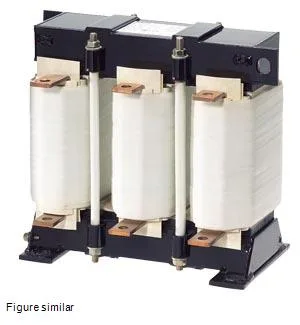
The Siemens 4EU4521-0BK10 is a commutating choke (Kommut.-Drossel f. Stromrichter) designed for converter duty. It's a 3-phase, 500V AC, 50Hz reactor rated for a continuous 2000A, with an inductance of 0.000014 H (14 µH) and a relative inductive voltage drop of 4% at rated current.
The 2000A continuous rating (Ith max) is the thermal current limit at 50Hz. This is the number that governs the choke's sizing against your converter's output — if your drive line pulls 2000A RMS at the fundamental frequency, this choke can handle it thermally. The 4% voltage drop (UK) at that current tells you the impedance the choke presents to the commutation circuit; it's the figure you need for coordination with the DC link and to ensure sufficient voltage margin remains at the motor terminals. The DC rated value is 2450.9A, which is higher than the AC rating — that's typical for a commutating choke where the DC component of the current sees a lower impedance path. Don't size on the DC number alone; the AC thermal rating is the binding constraint for 50Hz operation.
Deployment Context — Where This Choke Goes
This is an IP00, open-frame component. It's not a stand-alone, floor-mounted unit — plan for panel integration with adequate clearance for ventilation around the 0.46m wide, 0.435m tall, 0.293m deep body. The main circuit connection is via flat-type terminals (flat connector). That's the standard interface for high-current busbar work — expect to bolt copper bars directly to these lugs. No wire lugs or ring terminals; the connection is designed for bolted busbar or flat braid.
Thermal Class and Ambient — The Derating Reality
Rated for a 40°C ambient temperature with Class H insulation (180°C hot-spot rating per IEC 60085). That gives you headroom in a warm cabinet, but the 2000A rating is at 40°C ambient — if your enclosure runs hotter, the choke must be derated. Class H means the insulation system can survive short-term overloads that would cook a Class F or B unit, which is exactly what a commutating choke sees during a converter fault or heavy commutation notch.