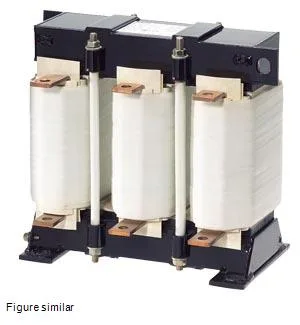
The Siemens 4EU4521-0BT10-0B is a three-phase commutating choke (line reactor) designed for use with power converters — specifically to limit the rate of rise of current (di/dt) during commutation, reducing stress on the converter's semiconductor devices and filtering harmonic content on the AC line. It is rated for a continuous current of 596 A at 400 V AC, 50 Hz, with an inductance of 0.12 mH per phase.
The 596 A rated current is the maximum continuous RMS current the choke can carry at its rated ambient of 40 °C without exceeding the thermal class H (180 °C) insulation system per IEC 60085. That is a high-current class — sized for large drives, not fractional-horsepower loads. The 0.12 mH inductance is relatively low, which is typical for a commutating choke: it provides enough impedance to limit di/dt without dropping excessive voltage at line frequency. The relative inductive voltage drop is 9.73 % at rated current and frequency — that is the voltage the choke consumes at full load, so the converter sees roughly 361 V instead of 400 V at the input terminals; factor that into the drive's DC bus voltage calculation. Total power loss at rated load is 877 W (563 W in the coil, 314 W in the iron core). That heat must be dissipated into the surrounding air — the IP00 enclosure means no protective housing, so the choke is an open-frame component intended for installation inside a ventilated cabinet. Mounting clearances and forced-air cooling should account for nearly 900 W of continuous heat rejection.
This choke sits on the AC input side of a three-phase converter (variable frequency drive or DC drive), between the line supply and the rectifier. Its job is to smooth the current waveform and limit commutation notches that can cause nuisance tripping of upstream protection or radiated EMI. The flat-type terminals are sized for bus-bar or large cable lugs — this is not a DIN-rail component; it is a panel-mounted reactor bolted to the enclosure floor or a mounting plate.