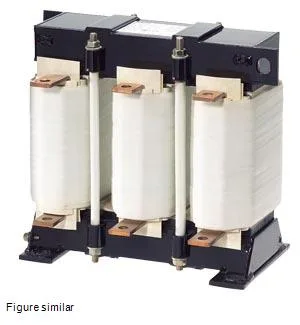
Siemens 4EU4551-4UA00 is a 3-phase AC mains choke — a line reactor — designed for the input side of a variable-frequency drive (Netzdrossel f. FU). Its job is to limit harmonic distortion, smooth inrush current, and protect the drive DC bus from line transients. The headline number is 1600 A rated current at 690 V AC, 50/60 Hz, which means it sits between a 690 V drive and the supply on a 1600 A feeder — a big industrial line, not a light-duty panel. The 2 % relative inductive voltage drop is the sweet spot for most drive applications: enough inductance to clean up harmonics without dropping so much voltage that the drive loses torque headroom.
Physical footprint and mounting reality
This choke measures 0.46 m wide by 0.435 m tall by 0.293 m deep — roughly the size of a small suitcase. It is IP00, meaning no enclosure: the core and windings are exposed. That is normal for a choke this size; it goes inside a drive cabinet or a dedicated enclosure, not on a wall. The main circuit connects via flat-type terminals, which means busbar or heavy-gauge cable lugs, not spring-clamp or screw terminals. Plan for bolted connections and a panel cutout that clears the 0.46 m width.
Thermal design and duty cycle
Rated for a 40 °C ambient with Class H insulation per IEC 60085 — Class H is 180 °C hot-spot, so this choke can run hot without cooking the winding varnish. Total power loss splits into 725 W in the coil and 325 W in the iron core, summing to about 1 kW of heat that must be ventilated out of the cabinet. That is the number the panel cooling engineer needs: 1 kW of continuous heat rejection from this one component.